Benchmarks
Every complex below is taken directly from NVIDIA's published Boltz-2 NIM performance page across 194 to 628 tokens, spanning single chains (
8eil, 7qsj, 8cpk) to a 3-chain trimer (8gpp), so we test on NVIDIA's own published benchmark suite rather than cherry-picking. Mac numbers are model-call seconds on one M5 Max: our build is a median of 3 runs and boltz-community (PyTorch MPS, the fastest previously available way to run Boltz-2 on a Mac) is a single run. NVIDIA's H100 columns are its published figures without disclosed step counts or timing boundaries.
Structure + affinity, seconds (lower is better)
NVIDIA's affinity times exceed its structure times, which suggests they include structure, so they are compared with the sum of our structure and affinity times.
- Our build (Boltz-MLX, Fast, M5 Max)
- boltz-community (M5 Max)
- H100 TensorRT (NVIDIA)
- H100 OSS PyTorch (NVIDIA)
Show as a table
| case | Our build (Boltz-MLX, Fast, M5 Max) | boltz-community (M5 Max) | H100 TensorRT (NVIDIA) | H100 OSS PyTorch (NVIDIA) |
|---|---|---|---|---|
| 8eil | 5.76 | 37.20 | 6.21 | 18.52 |
| 7qsj | 10.94 | 103.66 | 7.89 | 23.44 |
| 8cpk | 18.64 | 116.86 | 8.89 | 24.43 |
| 8gpp | 39.53 | 223.61 | 13.24 | 34.03 |
Structure only, seconds (lower is better)
Ours runs 200 structure steps on 8eil and 8gpp (the small-ligand rule) and 20 on the others; boltz-community runs 200.
- Our build (Boltz-MLX, Fast, M5 Max)
- boltz-community (M5 Max)
- H100 TensorRT (NVIDIA)
- H100 OSS PyTorch (NVIDIA)
Show as a table
| case | Our build (Boltz-MLX, Fast, M5 Max) | boltz-community (M5 Max) | H100 TensorRT (NVIDIA) | H100 OSS PyTorch (NVIDIA) |
|---|---|---|---|---|
| 8eil | 2.88 | 11.23 | 1.72 | 11.07 |
| 7qsj | 7.06 | 62.30 | 3.81 | 7.76 |
| 8cpk | 12.21 | 69.82 | 5.47 | 7.93 |
| 8gpp | 34.08 | 185.54 | 8.23 | 15.40 |
How to read it
- An H100 with TensorRT is faster on structure in every case, by up to 4.1× at 628 tokens.
- Against
boltz-community(the fastest previously available way to run Boltz-2 on a Mac), our build is 7.0× faster on average (5.7 to 9.5× across the four complexes) on structure + affinity. - Against NVIDIA's own published PyTorch numbers, structure + affinity is faster on
8eil,7qsj, and8cpk, and slower on8gpp. - Step counts, precision, and implementation all differ across columns. See experimental setup and limitations and caveats in the full report.
H100 cost vs. local Mac
$0/hr · ~$6K-$6.5K Mac
Demo 128 GB M5 Max laptop (zero hourly fee, runs on M1–M5; M1 Air speeds)
~$35K-$40K+ · ~$3.41/hr
Single NVIDIA H100 SXM GPU ($40K+ in a server; $3.41/hr SemiAnalysis cloud average; $2.75/hr our screening H100)
~526 ligands/hr
Cold virtual screening on M5 Max (6.84 s/ligand across 199 ligands)
~614 ligands/hr
Unbatched cloud H100 baseline (5.86 s/ligand; ~$5.55 per 1,000 ligands at $3.41/hr)
Zero software license fee, zero cloud queue, and inputs stay on 127.0.0.1 by default.
What it is
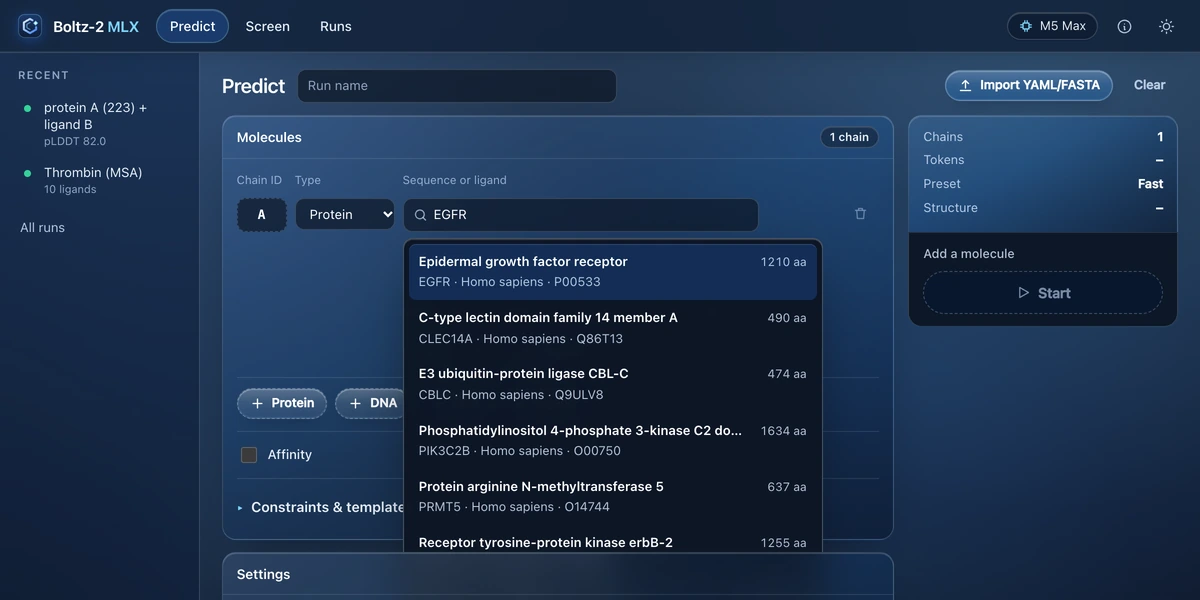
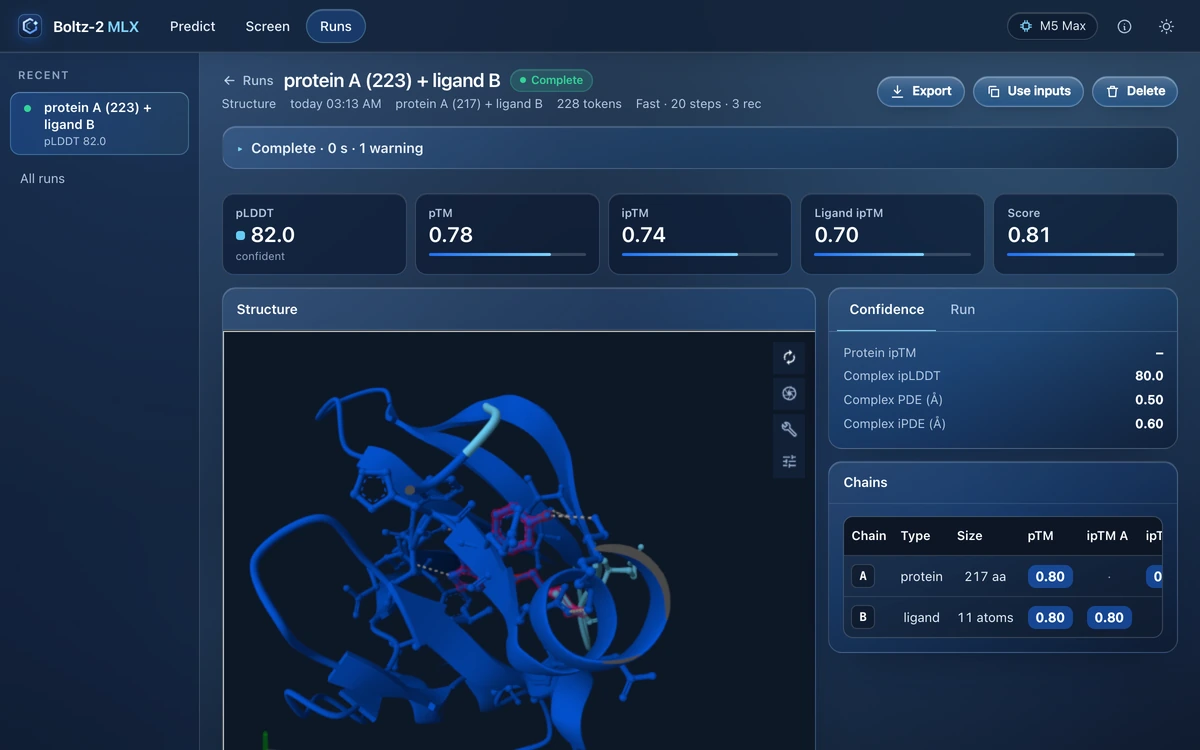
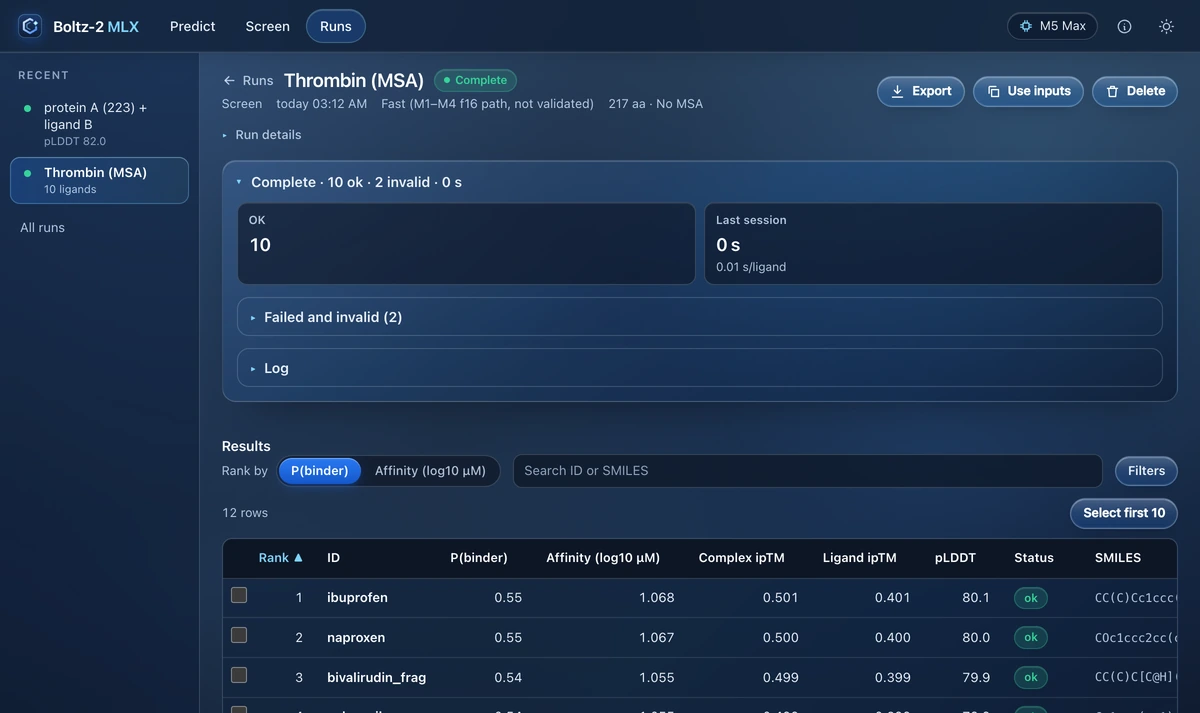
Boltz-2 predicts the 3D structure of protein, nucleic-acid and ligand complexes and, for one ligand, a binding affinity. Boltz-MLX ports inference to Apple's MLX so it runs on the GPU of an Apple Silicon Mac with no cloud, no queue, no account, and no license fee.
- Free and open sourceMIT license. Weights converted from the official checkpoints.
- Local and privateOne-time 6.2 GB weights download. Runs offline on
127.0.0.1with opt-in ColabFold MSA. - App and agent CLILocal GUI with UniProt/PDB search and 3D viewer, plus a
--jsonCLI andAGENTS.mdfor coding agents. - Any M-series MacM1 to M5 on macOS 26+. Fast is default on M5; M1 Air runs 117 tokens in 24.2 s (Full default on M1–M4).
The app
Links
- Technical report correctness, the Fast preset and its evidence, all benchmark tables, limits
- GitHub repository ↗ source, install instructions, AGENTS.md
- Boltz-2 (upstream) ↗ the original model and PyTorch implementation, by the Boltz authors
- NVIDIA Boltz-2 NIM performance page ↗ source of the H100 numbers